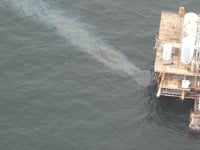
Deepwater Horizon oil spill study could lead to overhaul of cleanup processes worldwide
University of StirlingNew research by the University of Stirling could lead to major improvements in marine oil spill cleanup processes.
New research by the University of Stirling could lead to major improvements in marine oil spill cleanup processes.

Read the latest research news on air pollution, nanoplastics, waterborne illnesses and more in the Pollution channel on Newswise.
Researcher will discuss the study which involved a sleeping aid known as suvorexant that is already approved by the Food and Drug Administration (FDA) for insomnia, hints at the potential of sleep medications to slow or stop the progression of Alzheimer’s disease.

Here are some of the latest articles that have been added to the Marine Science channel on Newswise, a free source for media.

New research into oil spills’ effects finds surviving the initial event does not guarantee success for the popular sport fish mahi-mahi (Coryphaena hippurus). Exposed fish faced temporary increased predation and did not spawn for the entire observation time.

Researchers from the Gulf Long-term Follow-up Study (GuLF STUDY) found that workers involved in cleaning up the nation’s largest oil spill were 60% more likely than those who did not work on the cleanup to be diagnosed with asthma or experience asthma symptoms one to three years after the spill.
California’s McKinney Fire grew to become the state’s largest fire so far this year. The risk of wildfire is rising globally due to climate change. Below are some of the latest articles that have been added to the Wildfires channel on Newswise.
The latest research news in Climate Science on Newswise.
A team of U.S. and Chinese scientists mapping oil pollution across the Earth’s oceans has found that more than 90% of chronic oil slicks come from human sources, a much higher proportion than previously estimated. Their research, published in Science, is a major update from previous investigations into marine oil pollution, which estimated that about half came from human sources and half from natural sources.

Study suggests BP’s reputation suffered, but not the reputations or stock returns of other oil firms.

New research from the University of Portsmouth has shown a dramatic increase in shipping in the North East Atlantic. Scientists now warn that more monitoring in the area is required to help protect sea life on the at-risk register.


Study provides baseline for measuring impact of petroleum pollution on economically and ecologically important species along the Gulf Coast
Expert Q&A: Do breakthrough cases mean we will soon need COVID boosters? The extremely contagious Delta variant continues to spread, prompting mask mandates, proof of vaccination, and other measures. Media invited to ask the experts about these and related topics.
Florida State University and partner universities investigated current baseline conditions in the southern Gulf of Mexico to create a series of maps and guides that detail the distribution of carbon, nitrogen and the carbon-14 isotope.
Researchers have developed a new model to track the flow of an oil well spill, providing response agencies with the tools to better mitigate environmental damage to human and ecological systems.
The Gulf Sea Grant oil spill science outreach team -- which includes Monica Wilson of UF/IFAS -- -- received the National Superior Programming Award for its work synthesizing research results related to the 2010 Deepwater Horizon oil spill.
Rural counties continue to rank lowest among counties across the U.S., in terms of health outcomes. A group of national organizations including the Robert Wood Johnson Foundation and the National 4-H Council are leading the way to close the rural health gap.
Blood samples taken by first responders showed that individuals exposed to small amounts of oil from the spill suffered from hemolytic anemia—a condition that occurs when toxins enter the blood stream and damage red blood cells that carry oxygen to tissues.
The Deepwater Horizon oil spill in the Gulf of Mexico in 2010 is one of the most studied spills in history, yet scientists haven’t agreed on the role of microbes in eating up the oil. Now a research team at the Department of Energy’s Lawrence Berkeley National Laboratory (Berkeley Lab) has identified all of the principal oil-degrading bacteria as well as their mechanisms for chewing up the many different components that make up the released crude oil.
Effective warnings are a growing need as expanding global populations confront a wide range of hazards, such as a hurricane, wildfire, toxic chemical spill or any other environmental hazard threatens safety.
Scientists working in the Gulf of Mexico have found that contaminants from the massive 2010 Deepwater Horizon oil spill lingered in the subsurface water for months after oil on the surface had been swept up or dispersed. In a new study, they also detailed how remnants of the oil, black carbon from burning oil slicks and contaminants from drilling mud combined with microscopic algae and other marine debris to descend in a "dirty blizzard" to the seafloor.
Seabirds exposed to even a dime-sized amount of oil can die of hypothermia in cold-water regions, but despite repeated requests by Environment Canada, offshore oil operators are failing when it comes to self-monitoring of small oil spills, says new research out of York University.
Field experiment aims to uncover new clues about how oil and other pollutants move in the ocean.
The use of chemical dispersants meant to stimulate microbial crude oil degradation can in some cases inhibit the microorganisms that naturally degrade hydrocarbons, according to a new study led by University of Georgia marine scientists.
A new report from the Gulf of Mexico Coastal Ocean Observing System Regional Association details the first 10 years of the nonprofit organization's work to improve access to ocean observing data that helps to protect and preserve the Gulf and its residents.
According to University of Georgia’s Samantha Joye, one of the biggest challenges in evaluating the environmental impacts of the Macondo blowout was the lack of baseline data. She argues in a new article in the journal Science that environmental monitoring data is desperately needed to establish natural baselines.
Monica Wilson, the new Florida Sea Grant Gulf oil spill specialist, works with colleagues in several states to bring the latest science data to fishermen, businesses, tourism officials and more.
Five years ago the BP Deepwater Horizon oil platform exploded. The spill caused enormous environmental damage, but it also caused great stress among Gulf Coast residents. Even now, a significant percentage of people there continue to deal with anxiety, depression and other mental health issues, researchers say.
The survey shows that more than 34 percent of residents said they were dissatisfied or very dissatisfied with their community’s economy after the DWH oil spill, while only 15.6 percent felt that way before the oil spill.
It has been five years since the Deepwater Horizon explosion. Are Gulf states better prepared today to deal with the next disaster?
Following the Deepwater Horizon Oil Spill in 2010, many people were concerned that seafood was contaminated by either the oil or dispersants used to keep the oil from washing ashore. Ina University of Florida study, all seafood tested so far has shown “remarkably low contaminant levels,” based on FDA standards, and revealed that: • 74 percent of samples were below quantifiable limits; • 23 percent of samples were between 0.1-0.9 parts per billion, and; • 3 percent of samples were between 1.0 and 48 parts per billion.
Researchers from FAU's Harbor Branch Oceanographic Institute have published findings on the impacts of the Deepwater Horizon oil spill on marine organisms such as oysters, conch, shrimp, corals as well as marine plankton (microalgae or phytoplankton, rotifers or zooplankton), which provide the basis of coastal and oceanic food webs.
A mesh with a high-tech coating captures oil while water passes right through. With further development of this technology, the researchers say, "you could potentially catch an oil spill with a net."
Five years after the Deepwater Horizon oil rig explosion, researchers at the National Institutes of Health are actively working with Gulf region community partners, to learn if any human health problems resulted from the disaster and establish a new research response plan to be better prepared for future disasters.
The dispersant used to remediate the 2010 Deepwater Horizon oil spill in the Gulf of Mexico is more toxic to cold-water corals at lower concentrations than the spilled oil, according to a new study that comes on the eve of the spill’s fifth anniversary, April 20th.
April 20 is the fifth anniversary of the Deepwater Horizon explosion and subsequent oil spill, which resulted in the loss of 11 lives and substantial environmental and economic impacts for residents along the Gulf Coast region. In 2011, UF became the lead institution on one of four Deepwater Horizon Research Consortia grants, funded by the National Institute of Environmental Health Sciences.
New research from UAB suggests that Corexit EC9500A, an oil-dispersal agentl, contributes to damage to epithelium cells within the lungs of humans and gills of marine creatures. The study also identifies an enzyme that is expressed in epithelial cells across species that has protective properties against Corexit-induced damage.
Using advanced genomic identification techniques, researchers studying the impact of the Deepwater Horizon spill on communities of beach microbes saw a succession of organisms and identified population changes in specific organisms that marked the progress of the oil's breakdown.
Scientists have been searching for missing oil from the Deepwater Horizon oil spill, also called the BP oil spill, since 2010, and now Kevin Yeager, professor in the UK Department of Earth and Environmental Sciences, and his research colleagues may have solved the mystery.
A new study led by Florida State University Professor of Oceanography Jeff Chanton finds that some 6 million to 10 million gallons of oil from the BP oil spill are buried in the sediment on the Gulf floor, about 62 miles southeast of the Mississippi Delta.
It’s been 25 years since the Exxon Valdez spilled 11 million gallons of crude oil and nearly five years since the explosion of the Deepwater Horizon oil rig in the Gulf of Mexico gushed 200 million gallons of crude oil. Nearly 40 experts and eyewitnesses from science, government, industry and NGOs will gather to look back – and forward – at oil spill response.
Trustees could use the data to try to get the $585 million for ecosystem improvements and more fish in the Gulf.
 RSS
Medicine keyboard_arrow_right
Sciencekeyboard_arrow_right
Life keyboard_arrow_right
Business keyboard_arrow_right
Journal News keyboard_arrow_right
By Location keyboard_arrow_right
Meetings, Grants, and Events keyboard_arrow_right
RSS
Medicine keyboard_arrow_right
Sciencekeyboard_arrow_right
Life keyboard_arrow_right
Business keyboard_arrow_right
Journal News keyboard_arrow_right
By Location keyboard_arrow_right
Meetings, Grants, and Events keyboard_arrow_right