Water Chemist Available: New EPA Rule Limits PFAS in Drinking Water
Saint Joseph's University


Researchers reporting in ACS Nano have constructed a waterproof “e-glove” that wirelessly transmits hand gestures made underwater to a computer that translates them into messages. The new technology could someday help divers communicate better with each other and with boat crews on the surface.

Proteins known as oligomeric chaperones help suppress the formation of misshaped proteins that cause a variety of degenerative and neurodegenerative diseases, such as Alzheimer’s, Huntington’s, and Parkinson’s. In a new study, UT Southwestern Medical Center researchers identified a key feature necessary for one of these oligomeric chaperones, known as DNAJB8, to assemble from disparate parts and showed that the parts alone can reshape misfolded proteins. The findings, published in Structure, could lead to better ways to diagnose and treat these conditions.

A new look at a carbon capture solvent shows clusters and new types of carbon dioxide chemistry that could double carbon conversion.

Researchers have developed an automated workflow that could accelerate the discovery of new pharmaceutical drugs and other useful products. The new approach could enable real-time reaction analysis and identify new chemical-reaction products much faster than current laboratory methods.

A first-ever dataset bridging molecular information about the poplar tree microbiome to ecosystem-level processes has been released by a team of Department of Energy scientists led by Oak Ridge National Laboratory.

A research team led by the University of California, Irvine has built the first genetic reference maps for short lengths of DNA repeated multiple times which are known to cause more than 50 lethal human diseases, including amyotrophic lateral sclerosis, Huntington’s disease and multiple cancers.

As new paradigms in advanced computing take shape, computational chemistry researchers are finding new ways to solve challenging chemistry problems.

Chris Anderson is the newest addition to the Materials Research Laboratory (MRL) faculty, and he is ready to make a quantum leap into the world of materials science.

Lanthanide elements are important for clean energy and other applications. To use them, industry must separate mixed lanthanide sources into individual elements using costly, time-consuming, and waste-generating procedures. An efficient new method can be tailored to select specific lanthanides.
20240326113011.png&width=400&height=400)
Choosing paint for your home brings a lot of options: What kind of paint, what type of finish and what color? Water-based paints have emerged as “greener” and less smelly than solvent-based options. And they are often advertised as containing little-to-no volatile organic compounds (VOCs).

Researchers report in ACS Energy Letters that repositioning the electrode in a “blue energy” harvesting device — from the center of a see-sawing liquid-filled tube to the end where the water crashes with the most force — dramatically increased the amount of wave energy that could be harvested.

Astronomers have discovered the secrets of a starburst galaxy producing new stars at a rate much faster than our Milk Way. This research revealed many different molecules, more than ever seen before in a galaxy like this.

Low temperature, regenerative process saves energy and efficiently produces common chemical

New research from the University of Wisconsin–Madison decodes the evolutionary pathway of regulatory proteins, the molecules that help control gene expression.The findings from the Raman Lab in the Department of Biochemistry recently published their findings in the journal Cell Systems.
SARS-CoV-2 will eventually become resistant to the only effective oral treatment. The world needs another.

U.S. Department of Energy officials received a behind the scenes look at the Atmospheric Radiation Measurement (ARM) user facility’s Southern Great Plains (SGP) atmospheric observatory in Lamont, Oklahoma.

Recently, researchers have made significant progress in the field of soft matter self-assembly, unveiling innovative methods to create complex spherical packing superlattices. These developments pave the way for new approaches in fabricating detailed nanoscale structures.

The Princeton professor's research lies at the intersection of virology and proteomics.

Pharmaceutical waste and contaminants present a growing global concern, particularly in the context of drinking water and food safety. Addressing this critical issue, a new study by researchers at Bar-Ilan University’s Department of Chemistry and Institute of Nanotechnology and Advanced Materials has resulted in the development of a highly sensitive plasmonic-based detector, specifically targeting the detection of harmful piperidine residue in water.

Researchers from the University of Toronto and the Environmental Molecular Sciences Laboratory (EMSL) recently published research demonstrating that pyrite—the most abundant sulfide mineral in the Earth’s crust—is enriched in several trace elements. This is important for understanding past ocean chemistry from analyses of sedimentary pyrite. Knowledge from this research will help scientists use pyrite trace metal concentrations to analyze and quantify early ocean chemistry and, as a result, the ocean’s evolution through time.

Researchers at PNNL have developed a new technique to get a high-resolution look at how—and why—corrosion happens.

Scientists at the U.S. Department of Energy’s (DOE) Brookhaven National Laboratory and the University of North Carolina Chapel Hill (UNC) have demonstrated the selective conversion of carbon dioxide (CO2) into methanol using a cascade reaction strategy.
Though it’s known that tiny sites like soot and bacteria help water freeze, the fundamentals of how ice forms are vague. Scientists have now developed a theoretical model showing how structural details on surfaces influence water’s freezing point. They will present their results at ACS Spring 2024.
The increasing use of lithium-ion rechargeable batteries likely means more environmental contamination. Researchers have explored how lithium accumulates in crawfish, with implications for the environment and public health. They will present their results at ACS Spring 2024.
Dropping wearable electronics, or hitting them really hard, usually breaks the devices. Now, researchers report on a flexible and electrically conductive material with “adaptive durability,” getting stronger when it is hit. They will present their results at ACS Spring 2024.
Quantum dot research just won a Nobel Prize, and now, the applications for nontoxic quantum dots are being expanded. One team of researchers has designed carbon- and sulfur-based dots to help clean up the environment. They will present their results at ACS Spring 2024.

New research from The Grainger College of Engineering suggests that observing how heat flows in conjunction with electricity can give important insights into battery chemistry.
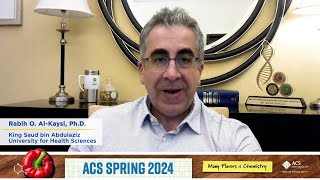
Rabih Al-Kaysi’s molecular motors look like tiny worms, but they’re actually crystallized molecules that move in response to light. These machines could someday solve real-world problems, like being used as drug-delivery robots. The researchers will present their results at ACS Spring 2024.
Many disposable diapers and sanitary pads contain plastic and need centuries to decompose. Now, researchers are replacing the plastic with parts made from food waste. That could lead to biodegradable diapers and pads that could be used as fertilizer. They’ll present their results at ACS Spring 2024.
Mucus is critical to human health. To explore how, researchers synthesized its major component, sugar-coated proteins called mucins, and discovered that changing the mucins of healthy cells to be more cancer-like made cells act more cancer-like. They will present their results at ACS Spring 2024.
These chemists are investigating ways to reliably minimize alcohol and tailor taste profiles during the kombucha fermentation process to help home and commercial producers optimize their funky brews. They will present their results at ACS Spring 2024.
Ants are commonly eaten in some parts of the world, roasted and eaten whole or ground and used to add flavor and texture to dishes. Each species has its own unique flavor, and researchers now report the aroma profiles of four species of edible ants. They will present their results at ACS Spring 2024.
Some animals can withstand frigid weather, thanks to the insulating properties of the hollow hairs that make up their coats. Little was known about the hairs, but researchers have now discovered that their inner structure changes with the seasons. They will present their results at ACS Spring 2024.

Machine learning interatomic potentials (MLIP)s have become an efficient and less expensive alternative to traditional quantum chemical simulations.

A study in ACS Central Science shows that applying voltage to certain objects forms chemical bonds linking the objects together. Reversing the direction of electron flow separates the materials. This could help create biohybrid robots, improve biomedical implants and enable new battery technologies.

The Environmental Molecular Sciences Laboratory (EMSL) is accepting applications from undergraduate and graduate students, and postdoctoral researchers for the 2024 EMSL Summer School focused on fungal research. EMSL is providing transportation and hotel accommodations for up to 25 students who are selected through the application process.

An international team of scientists captures the first clear evidence in the field of Criegee intermediates, which help form aerosols in the atmosphere that impact air quality and human health.

Researchers flip the switch at the nanoscale by applying light to induce bonding for single-molecule device switching.
Discover BMB, the annual meeting of the American Society for Biochemistry and Molecular Biology will be held March 23–26 in San Antonio. Secure your front-row seat to cutting-edge findings, approaches and technologies in the biological sciences by registering for a complimentary press pass to attend in person or to access press materials electronically.

Want to remove microplastics from water? Try brewing it for a cup of tea or coffee! Research reported in Environmental Science & Technology Letters shows that by boiling then filtering tap water, up to 90% of the nano- and microplastics present could be removed.

Molecules that are induced by light to rotate bulky groups around central bonds could be developed into photo-activated bioactive systems, molecular switches, and more.

A subpopulation of gut bacteria given a commonly used antibiotic became "persisters" that were able to survive without developing true resistance, UT Southwestern Medical Center scientists discovered. Their findings, published in Cell Host & Microbe, could lead to better ways to fight bacterial infections.

A report from the world’s leading scientific and medical experts on hormone-related health conditions raises new concerns about the profound threats to human health from endocrine disrupting chemicals (EDCs) that are ubiquitous in our surroundings and everyday lives.

A preclinical study led by a team of researchers at Roswell Park Comprehensive Cancer Center highlights the potential of a novel two-drug treatment strategy targeting p53-mutant cancers.
Identifying the microorganisms behind a dental infection can be a lengthy and expensive process. Now, researchers reporting in ACS Applied Materials & Interfaces have designed a chemical sensor array, or an artificial tongue, that distinguishes dental bacteria and can inactivate them.

When you get a tattoo, do you know what you’re putting under your skin? According to new research from Binghamton University, State University of New York, the ingredient labels on tattoo ink don’t match the actual substances in the bottle.

UT Battelle LLC, a management contractor for the U.S. Department of Energy’s (DOE) Office of Science, has awarded $1.2 million to Stony Brook University researchers for a study to test surface pathogen prevention.
Nearly 30 years ago, scientists discovered a unique class of anticancer molecules in a family of bryozoans, a phylum of marine invertebrates found in tropical waters.
 RSS
Medicine keyboard_arrow_right
Sciencekeyboard_arrow_right
Life keyboard_arrow_right
Business keyboard_arrow_right
Journal News keyboard_arrow_right
By Location keyboard_arrow_right
Meetings, Grants, and Events keyboard_arrow_right
RSS
Medicine keyboard_arrow_right
Sciencekeyboard_arrow_right
Life keyboard_arrow_right
Business keyboard_arrow_right
Journal News keyboard_arrow_right
By Location keyboard_arrow_right
Meetings, Grants, and Events keyboard_arrow_right